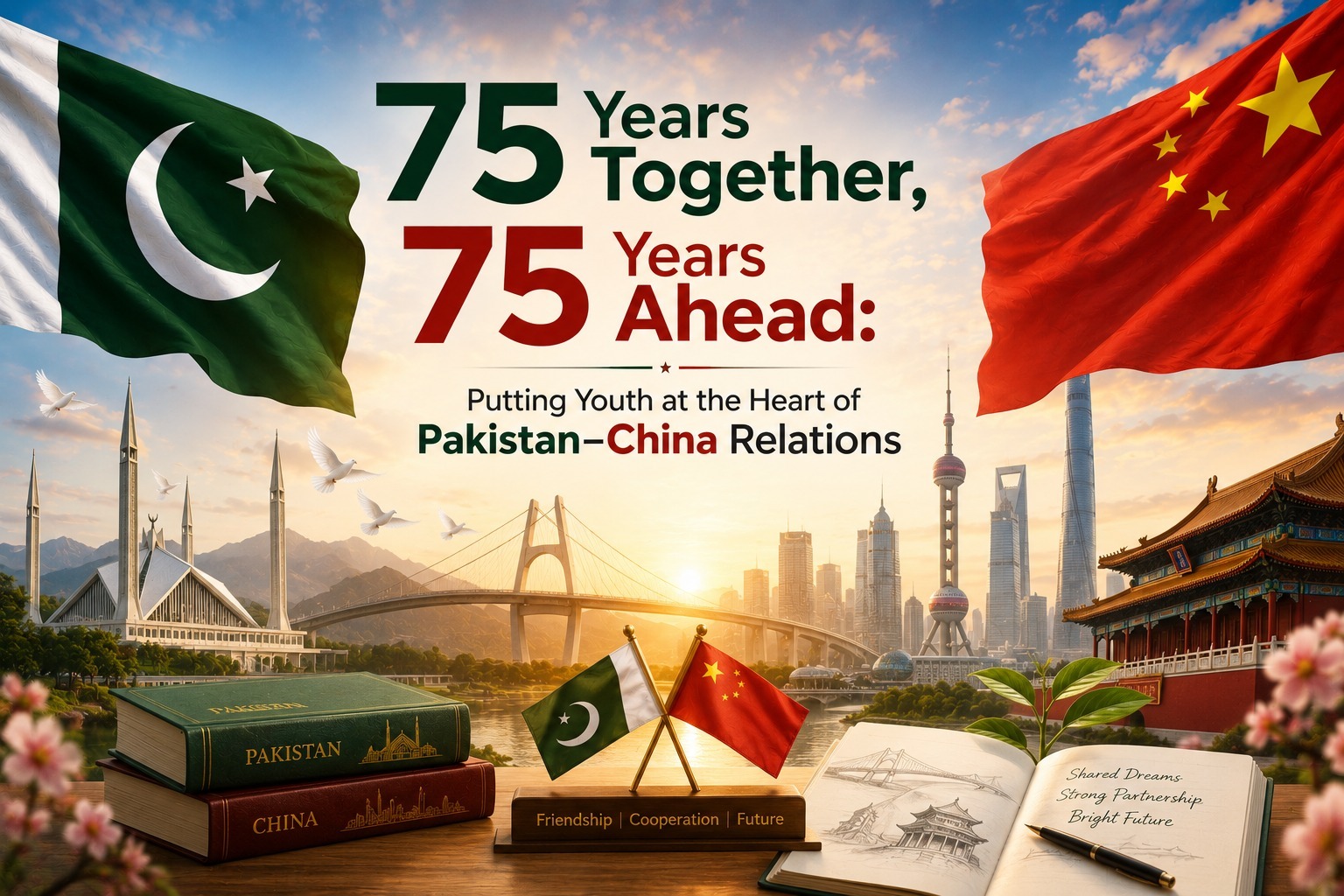
ISLAMABAD (Sapeher Times) 75 Years Together, 75 Years Ahead: Putting Youth at the Heart of Pakistan–China Relations


By Ms. Yusra Binte Nisar, Research Assistant at Pakistan Research Center for a Community with Shared Future (PRCCSF), Islamabad
ISLAMABAD (Sapeher Times) Somewhere today, a young student sitting in a classroom, in Islamabad, Lahore, Beijing or Shanghai, is learning something that has nothing to do with diplomacy. It could be artificial intelligence, medicine, engineering, business, or agriculture. He may never get a chance to sit across a table to negotiate an agreement between the two countries. But the knowledge he gained, the skills he learned, ideas he exchanged, and the friendships he developed in that classroom could quietly influence the Pakistan–China relations for years to come.
The Platinum Anniversary of Pakistan-China diplomatic relations is more than simply celebrating decades of brotherhood. And it is a moment to look forward. It is the right time to ask questions such as what will be the future of Pakistan-China friendship and who will carry this legacy? 75 years ago, in May 1951, Pakistan and China established a relation based on trust, mutual respect, cooperation, and support for each other. It was a promise to stand together in every difficult time. Throughout the decades, both nations have expanded their cooperation beyond politics into defense and security and with every passing year, the partnership is getting stronger.
For this friendship to remain strong for the next 75 years, one group must be placed at its heart: the youth.
Young people are the largest source of energy, ideas and ambition in both Pakistan and China. They are also the generation who will take the relationship further. The decisions of today will shape the future of tomorrow for young Pakistanis and Chinese. Therefore, the 75th anniversary is not only a time to look back at everything Pakistan and China have achieved together. It is also a chance to look ahead and focus on creating more opportunities for youth to connect, learn and build together.
Over the years, China has given opportunity to thousands of Pakistani students to study in China. These exchanges have brought young people from the two countries closer. When students return home, they don’t just leave with a degree, they leave with core memories, friendships and a better understanding of each other’s cultures and traditions. They start viewing Pakistan-China relations in a completely different way. Such changes may seem very small but the impact is huge. In the long run, these small personal connections can become the strongest building blocks of a lasting Pakistan–China friendship.
Education can become one of the most powerful bridges between Pakistani and Chinese youth. China has made remarkable progress in science, technology, artificial intelligence, renewable energy, agriculture and modern industry. Pakistan has a young and talented population with great potential in many of these fields. Greater academic exchanges, scholarships, joint research programmes and university partnerships can bring this potential together.
The curious nature of young generation can also be very helpful. They question old ideas, experiment with new ones and are willing to take risks. Pakistan and China can use this energy for addressing some major challenges modern world is facing nowadays. These include climate change, cybercrime, AI, water management and misinformation. The aforementioned problems transcend national borders and only young people can bring the fresh thinking and energy needed to tackle them. It makes youth the most valuable dimension of modern Pakistan-China relations
The future of Pakistan–China relations will not be shaped only in government offices or business meetings. It will also be shaped in classrooms, laboratories, technology centers and universities. A Pakistani student working with a Chinese student on a new technology project is, in a very real sense, building the future of bilateral relations.
Technology offers another major opportunity. Today’s youth are digital citizens. They communicate through social media, learn through online platforms and work across borders using technology. Pakistan and China can turn this digital connection into meaningful partnership. Joint programmes for young entrepreneurs, technology competitions, innovation labs and online learning platforms will be very helpful to advance this friendship.
The China Pakistan Economic Corridor (CPEC) has already entered its second phase which is also known as the CPEC 2.0. While the first phase focused on infrastructure development, the 2nd one focuses on industrial cooperation. This phase is crucial for youth. Large infrastructure projects matter but they are only one aspect of Pak-China relations. The future of bilateral relations will not only be shaped by roads, ports, and economic zones. It will increasingly depend upon students, researchers, scientists, entrepreneurs, engineers, medical experts, media professionals, and young innovators from both nations.
The next generation of Pakistan–China economic cooperation should therefore give young people a central role. Special training programmes, internships, start-up opportunities and professional exchanges can help Pakistani youth gain valuable skills while also creating opportunities for Chinese companies and institutions to connect with Pakistan’s young talent.
There is also great potential in cultural exchange. Young people can be ambassadors of friendship without having official titles. It is when Pakistani and Chinese students, artists, athletes, content creators and volunteers come together that stereotypes can be challenged and similarities between their societies can be found.
Culture can make the relationship more human. Thanks to the Confucius Institutes established across Pakistan that younger generation is not only learning the Chinese language but the celebration of Chinese cultural events helps them gain deeper understanding of Chinese traditions, history and modern society. On the other side, Chinese youth can discover the warmth and diversity of Pakistan through its music, food, art and heritage. With social media, films and digital platforms making it easier to share these experiences, young people have more ways than ever to discover each other’s worlds.
Pakistan’s young population is a major national strength. If they are given the right education, skills, opportunities, and dedicated platforms, they can be the engines of economic growth and innovations. China is experienced in development and technology and can be a very valuable partner on this journey. These qualities, when combined together, can take the Pakistan–China partnership to greater heights.
So the 75th anniversary should be seen as the beginning of a new chapter. The first 75 years made the foundation; the next 75 years can be built by a new generation. This generation should not only inherit the Pakistan-China friendship. It should be given the chance to shape and strengthen it.
Governments, universities, businesses, and civil societies must also play their due role by giving young people from both countries more chances to connect and work together. This could include giving them small grants to turn community ideas into real projects, providing them failure-friendly entrepreneurship spaces, connecting them to policy makes through youth advisory boards, or bringing them together to work on real problems such as water, education, transport, or climate. The point is not simply to give young people something to do. It is to give them a genuine chance to create, influence, and be heard.
The strength of Pakistan–China relations has always been its ability to look towards the future. As both countries celebrate 75 years of diplomatic friendship, the message should be clear: the next chapter belongs to the youth.
The friendship of the past 75 years gives us reason to be proud. The possibilities of the next 75 years give us even greater reason to be hopeful. If Pakistan and China put their young people at the center of their partnership, the bond between the two countries can become deeper, more innovative and more dynamic than ever before.
The first 75 years built a bridge between two nations. The next 75 years can see their young people cross that bridge together—carrying new ideas, creating new opportunities and building a future based on shared progress and lasting friendship.