ISLAMABAD (Sapeher Times) Saudi Arabia, Pakistan. Turkey: three different systems of government, but one goal.

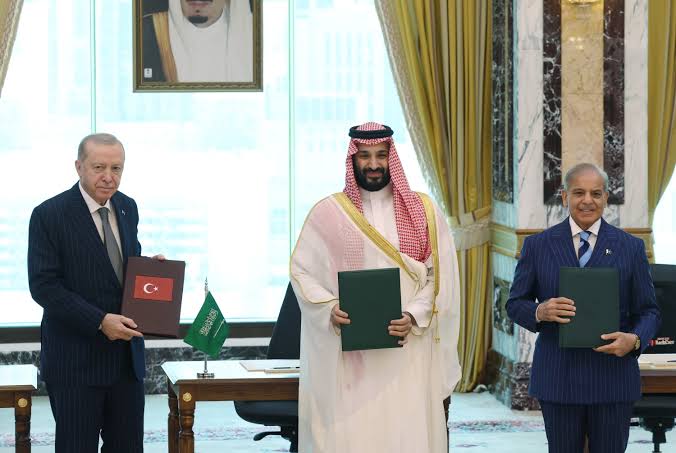
ISLAMABAD (Sapeher Times) Saudi Arabia, Pakistan, and Turkey have three different systems of government, but are united for one goal,
The most unique and historic feature of the Mecca Joint Defense Agreement is that the systems of government of the three countries involved in it are completely different from each other, but the strategic necessity and the larger goal of regional security have united them. Furthermore, according to Asghar Ali Mubarak, a senior political and diplomatic analyst of Pakistan, this is an unusual example in international relations where national interests and common survival have been given priority over political ideologies. The defense cooperation of these three different systems is as follows:
1. Saudi Arabia: Absolute Monarchy
System of Government: Saudi Arabia has a centuries-old traditional monarchy system, where all important decisions revolve around the royal family, especially the Crown Prince and Prime Minister Prince Muhammad bin Salman. There are no Western-style parliaments or political parties here.
Saudi Arabia’s primary role in this alliance is as a financial engine and geographic center. It is funding the alliance’s joint defense and production projects through its vast economic resources and oil wealth.
2. Pakistan: Parliamentary Democracy, System of Government
Pakistan has a federal parliamentary democracy, where civilian Prime Minister Shahbaz Sharif is the head of the administration, and parliament enacts legislation.
However, the strategic role of the Pakistan Army and the military leadership of Field Marshal Asim Munir is very strong and decisive in the country’s foreign and security policies.
Pakistan is the largest military pillar of this alliance and the only nuclear power. Pakistan’s more than 1.7 million active and reserve military personnel and nuclear deterrent make this alliance as strong as NATO.
3. Turkey: Presidential Republic
Turkey is a presidential democracy under a secular constitution, where President Recep Tayyip Erdogan has broad executive powers and is directly elected by popular vote. Turkey is also a full member of NATO. Turkey is the technical and industrial brain of this alliance.
Turkey is providing the alliance with the latest Western and NATO-standard technology through its highly advanced and self-sufficient defense industry, including fifth-generation fighter jets and drones.
One goal of three different systems:
“Defense solidarity”: According to political science experts, these three countries have proven that, by setting aside the differences in their domestic systems of government, when survival and regional security are at stake, it is not necessary to have the same political system for unity. This unique partnership has given the three countries the following benefits:
Saudi Arabia has gained the practical protection of two large Muslim armies by reducing its dependence on American security.
Pakistan has gained strong financial and energy security from the Gulf to support its declining economy.
Turkey has found a huge and stable market for its defense products in the Middle East and South Asia.
The combined annual military budget of the three major Muslim countries, Saudi Arabia, Turkey, and Pakistan, included in the Mecca Joint Defense Agreement, exceeds approximately 125 billion US dollars.
From a geopolitical and financial perspective, the comparison of the defense budgets of these three countries is very interesting, as it reflects three different economic sizes and defense priorities.
The following is a comparative overview of the defense budgets (fiscal year 2025-2026): Saudi Arabia’s military budget is one of the largest in the world, currently between $72 and $83 billion. This amount is more than twice the combined military budgets of Pakistan and Turkey.
Most of Saudi Arabia’s budget is spent on the purchase and maintenance of advanced American and European air systems (F-15SA), Patriot missiles, and THAAD air defense systems.
Under the Mecca Agreement, Saudi Arabia is the primary financier of the alliance’s joint manufacturing projects.
Turkey’s defense and internal security budget has increased to $27 to $30 billion (approximately 2.155 trillion lira) due to recent regional conflicts and a modernization drive.
As a NATO member, Turkey aims to spend more than 2 percent of its GDP on defense. Turkey spends a large portion of its budget on research and development (R&D) of its domestic defense industry (including the KAAN fifth-generation aircraft, Steel Dome air defenses, and Bayraktar drones) rather than imports, with exports exceeding $7 billion.
Pakistan has increased its defense budget to Rs 3,000 billion (about $10.8 billion) despite severe economic challenges and pressure from the IMF program in view of the regional security situation.
Pakistan’s budget is much smaller than Saudi Arabia’s and Turkey’s in US dollar terms, but despite this small budget, Pakistan maintains the largest active military force in the alliance with 1.7 million active and reserve personnel and the only nuclear strategic capability.
Most of Pakistan’s budget is spent on military salaries, pensions, operational expenses, and defense platforms like the JF-17, which it shares with China.
According to military experts, the most beautiful aspect of the Mecca agreement is that this budgetary disparity becomes each other’s strength in the military arena. Moreover, the military alliance and joint exercises between Saudi Arabia, Pakistan and Turkey play a crucial role in enhancing the security and defense capabilities of the region. The three countries regularly conduct joint military, air and naval exercises aimed at benefiting from each other’s experiences in counter-terrorism, maritime security and air defense. Exercises such as “Al-Kisaah” and “Al-Samsam” between Pakistan and Saudi Arabia hone counter-terrorism and mountain warfare skills, while the “Ataturk” exercises between Pakistan and Turkey strengthen the operational capabilities of both armies. In addition, the three countries actively participate in the “North Thunder” naval exercises hosted by Saudi Arabia and “AMAN” naval exercises hosted by Pakistan. This military cooperation is not limited to exercises, but the Pakistani army has been the guarantor of Saudi Arabia’s geographical security, while Turkey further strengthens this alliance by providing the latest defense weapons and training to Pakistan’s air and naval forces. Despite having three completely different systems of government, Saudi Arabia, Pakistan and Turkey are strongly linked to each other under a common goal of regional stability, defense self-reliance and economic modernization. Saudi Arabia provides financial capital and energy security by investing billions of dollars in Pakistan’s agriculture and mining sectors and funding major infrastructure projects in Turkey. On the other hand, Turkey is playing the role of a technological and industrial powerhouse, providing Pakistan with modern warships and providing Saudi Arabia with the latest drone technology under historic defense agreements. Pakistan acts as an important bridge between the two countries, offering a strategic trade corridor through CPEC, a large pool of skilled manpower and a strong military force to ensure the security of the Gulf. These three countries are combining their individual strengths – Saudi capital, Turkish technology and Pakistan’s strategic position – to form a mutual Muslim alliance centered on shared economic survival and global political influence. The ‘MILGEM’ project between the Pakistan Navy and the Turkish defense industry is a prime example of this partnership. Under this project, state-of-the-art warships (such as the Babur-class corvette) are being developed. The most notable aspect of this project is the transfer of technology to Pakistan. These ships are being manufactured not only in Turkey but also in Pakistan’s Karachi Shipyard and Engineering Works (KS&EW), which has immensely increased Pakistan’s naval defense production capacity. Joint centers for helicopter maintenance, local production of spare parts, and upgradation have been established between Pakistan and Turkey in the field of military aviation. Work is underway on sharing modern armored vehicles and tank technology between Heavy Industries Taxila (HIT) and Turkish defense institutions so that the ground forces of both countries can be provided with the latest defense weapons. The biggest benefit of this production collaboration comes from the financial support of Saudi Arabia. Under the agreement, Saudi Arabia is providing substantial funds for all these major manufacturing projects, while Pakistan’s manpower and military experience and Turkey’s technology are completing these projects rapidly. This tripartite model is freeing the three countries forever from the blackmail of expensive weapons from Western countries. Pakistan, Saudi Arabia and Turkey have signed a historic defence pact in Mecca. Under the NATO-style pact, an attack on any one of the three countries will be considered an attack on all three, further enhancing Pakistan’s importance in the security of the Gulf.
It is an unwavering principle of Pakistan’s foreign and military policy that Pakistan will intervene militarily if Saudi Arabia’s territorial integrity and holy sites (Haram Al-Sharif) are threatened.
Under its mutual defence agreements, Pakistan has deployed thousands of military personnel, a squadron of JF-17 fighter jets and a state-of-the-art air defence system (HQ-9 Air Defence) to Saudi Arabia to counter security threats looming over the Gulf. Kuwait recently ratified a major defence manifesto agreement with Pakistan, under which Pakistan is providing support to the Kuwaiti army in the areas of drone technology, intelligence sharing and air defence. Following the increasing number of attacks on commercial vessels in the Red Sea and Gulf of Aden, Pakistan is included in a 14-nation maritime defense alliance led by Saudi Arabia to secure the Gulf’s oil supply lines. The Saudi-led multinational maritime defense alliance was established in Riyadh in late July 2026 with the primary objective of providing security to global trade and energy supply lines in the Gulf of Aden, the Red Sea and the Bab al-Mandab Strait. The permanent headquarters of the 14-nation alliance has been established in Saudi Arabia, and Saudi Rear Admiral Abdullah bin Salem al-Shehri was appointed as the first commander of the force in early August 2026. The founding members of the alliance include Saudi Arabia, Pakistan, Turkey, Kuwait, Bahrain, Qatar, Egypt, Jordan, Yemen, Bangladesh, Nigeria, Sudan, Djibouti and Somalia, while Oman and the United Arab Emirates are not part of it. The force works through intelligence sharing, joint maritime patrols and operational planning, the structure of which is scheduled for another important meeting in mid-August 2026 to finalize. In this alliance, Pakistan’s experienced navy and Turkey’s modern naval technology together provide the strongest defense core for Gulf security. In the event of tension in the Gulf, Pakistan, as a responsible nuclear power, has always played the role of a diplomatic mediator between Saudi Arabia, Iran, and other Gulf countries to prevent war in the Gulf. Preparations for the first formal joint maritime patrol under the Multinational Maritime Defense Alliance are being completed rapidly, as Saudi Rear Admiral Abdullah bin Salem Al-Shehri was appointed as the first commander of this force in early August after the formation of the alliance in late July 2026. This first patrol will focus on the highly sensitive sea lanes of the Red Sea, Bab al-Mandab Strait and the Gulf of Aden, with the main objective of preventing attacks on trade routes and providing foolproof security to international energy supply lines. All operations of this patrol will be monitored from the permanent headquarters and the Combined Marine Operations Center in Saudi Arabia, where real-time intelligence and satellite information will be shared among all 14 member countries. In this first patrol, the Pakistan Navy’s modern patrol ships (Tughral-class frigates) and the Turkish-made MILGEM-class corvettes will provide the main defensive cover, which are equipped with the latest anti-ship and air defense systems. This naval mission will also be supported by Turkey’s Bayraktar Akinci drones and Saudi Arabia’s aerial surveillance system, which will monitor the sea lanes from the air around the clock. A permanent weekly schedule for monitoring the sea lanes will be finalized after reviewing the initial results of the first joint patrol at the AGL meeting to be held in mid-August. The most modern ships of the Pakistan Navy, especially the Tughral-class frigates and the Babur-class mulgam corvettes, included in this naval alliance, are equipped with the world’s most advanced weapons and defense systems. For air defense, the Tughral-class frigates are equipped with a 32-cell vertical launch system that fires HQ-16 missiles that destroy enemy aircraft and missiles up to 70 kilometers, while the Babur-class corvettes are equipped with Europe’s most advanced Albatros NG missile system that protects commercial ships from attacks by drones and guided bombs. For anti-ship and land attacks, these ships are equipped with Pakistan’s locally developed ‘Harba’ and modern supersonic anti-ship cruise missiles, which have a range of 280 to 400 kilometers and target enemy ships while floating along the sea surface at very high speed. To prevent sudden and very close air attacks or suicide drones, these ships are equipped with the Turkish-made ‘Special Asilsan Gökdeniz’ 35 mm close-in weapon system and Otto Melera 76 mm main guns, which can fire hundreds of rounds in seconds. In addition, to deal with the threat of submarines under the sea, they are equipped with modern sonar systems like ‘Mark 32’ lightweight torpedo tubes and anti-submarine Horse-900, which detect any underwater threat in advance and render it ineffective. Pakistan not only provides manpower to the Gulf countries, but has also become the strongest security pillar of the Gulf portfolio with its nuclear capability, strategic depth, and the Mecca Defense Treaty.