ISLAMABAD (Sapeher Times) Pakistan’s global role in promoting youth mental health through sports

ISLAMABAD (Sapeher Times) Pakistan is ensuring youth participation in sports at the government level to prepare them for international competitions. The aim is to promote self-confidence, positive thinking, and a healthy lifestyle among the youth.
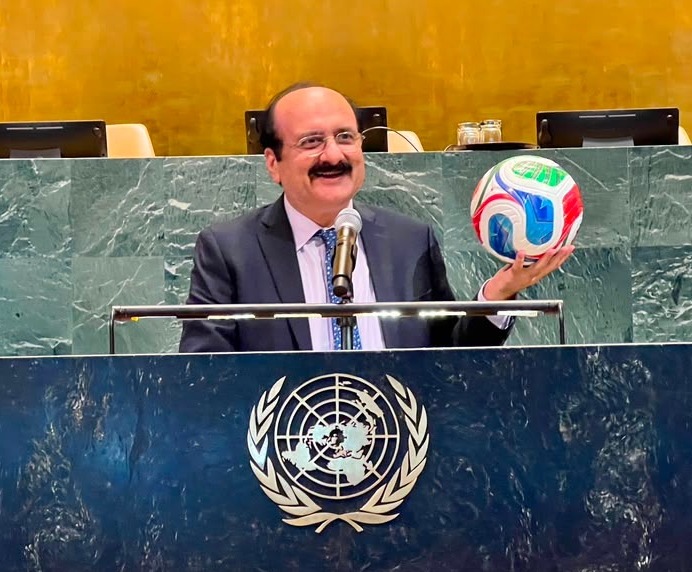
Chairman Prime Minister’s Youth Program Rana Mashhood Ahmed Khan, while addressing a prestigious United Nations event, highlighted Pakistan’s key role in promoting youth mental health, well-being and global solidarity through sports.
On this occasion, he also presented the official match ball of the FIFA World Cup 2026, “TRIONDA”, manufactured in Pakistan, to the international community. Addressing the event, Chairman Rana Mashhood Ahmed Khan said that “TRIONDA” is not just a football but a testament to Pakistani craftsmanship, immense skill, and world-class craftsmanship. He expressed pride and said that Pakistan has previously produced official match balls for several FIFA World Cup competitions, which is clear proof of the high capacity and international standards of our national industry. Emphasizing the importance of sports, he said that sports are the most effective means of bringing people from different countries, cultures, and societies closer to each other. When youth from different backgrounds play together, they learn to stand together, which promotes positive thinking, a healthy lifestyle, and social harmony in society. Under the dynamic leadership of Prime Minister Muhammad Shehbaz Sharif, the Prime Minister’s Youth Program is taking very effective steps to improve the self-confidence, determination, and mental and physical health of the youth through sports. Empowering the youth at all levels and enabling them to play a constructive role in building a peaceful and prosperous society is the top priority of the Prime Minister’s Youth Program. Pakistan will continue to play its positive and active role in the field of sports and the development of youth at the global level in the future as well. FIFA World Cup Match Balls: The Pakistani city of Sialkot is the largest football manufacturing hub in the world. Pakistan has proven its craftsmanship and industrial prowess on the global stage by producing official match balls for the FIFA World Cup on several occasions (such as ‘Brazuka’, ‘Al-Rahla’ and ‘TRIONDA’ for 2026).
Pakistan has been a global voice (such as in recent United Nations programmes) for promoting mental health, social cohesion and solidarity among youth through sports.
The Pakistani city of Sialkot is considered to be the largest hub for manufacturing sports equipment in the world, where the equipment is unmatched in its durability and sophistication. The world’s biggest sporting event, the FIFA Football World Cup, is incomplete without Sialkot. Pakistan has made a name for itself worldwide by producing the “TRIONDA” football for the 2014 (Brazuca), 2018 (Telstar 18), 2022 (Al Rihla), and now the current 2026 World Cup. These footballs are made using the latest technology of thermo-bonding. The world’s most famous brands like Adidas, Nike, and Puma get their cricket bats, gloves, footballs, and other protective equipment manufactured by expert craftsmen in Sialkot. This industry strengthens Pakistan’s economy by earning billions of dollars in foreign exchange annually and provides employment to millions of families. The modern footballs manufactured in Sialkot for the FIFA World Cup are completely different from traditional footballs. Now, instead of hand stitching, the world’s latest technology is used.High-quality polyurethane (Polyurethane/PU) is used for the outer surface of the football. This material makes the ball waterproof and maintains its speed in the air. Synthetics and fabric layers are applied under the PU sheet so that the ball remains strong and does not lose its round shape. A modern football usually consists of 20 to 32 panels. These panels are cut very precisely using modern laser or die-cutting machines so that the size and weight of each panel are exactly the same. This is the most important and advanced step. The panels are connected to each other using a special adhesive instead of thread. The panels are placed around a sulfuric bladder and pressed into extremely hot molds. Due to the heat, the panels are connected to each other in such a way that not a single stitch or hole is visible on the ball. The advantage of this technology is that during rain, water does not get inside the ball at all and its weight does not increase. A high-grade latex or butyl bladder is used to prevent air from entering the ball. This bladder maintains the air pressure, which makes the ball fly perfectly straight. A special type of valve is installed, which is easy to inflate but completely prevents air from escaping during play. After the thermo-bonded football is manufactured, it has to undergo FIFA’s strictest tests in the laboratory. The ball is measured from 16 different angles to ensure that it is 100% round. According to FIFA law, the weight of the ball must be between 420 and 445 grams. The ball is dropped from a height of 2 meters onto a steel floor, and it is observed how high it rises. The ball is rolled in water to see if it is absorbing water.Pakistan’s global role in the promotion of sports has always been very important and influential. Pakistan has not only given the world great players but has also played an exemplary role in the global sports industry, peace, and diplomacy. Famous brands from all over the world get cricket, hockey, tennis, and martial arts equipment manufactured in Sialkot, which is a symbol of Pakistan’s world-class quality. Pakistan introduced glass-walled courts to modernize the game of squash, which made it possible to watch this game on TV and increased its global popularity. ‘Doosra’ and ‘Reverse Swing’ in Cricket: Pakistani bowlers gave the world of cricket techniques like ‘Reverse Swing’ and ‘Doosra’, which changed the course of modern cricket forever. Pakistan is the only country in the world to simultaneously hold world titles in four major sports (cricket, hockey, squash and snooker). Pakistan played a fundamental role in popularizing field hockey globally and won the Hockey World Cup a record 4 times. Pakistan has always used sports to bridge the gap between different countries and cultures and establish peace. The Pak-India cricket series has been a great example of this, which has helped reduce political tensions many times. The history of hockey invented by Pakistan is incomplete without mentioning Pakistan, as the credit for modernizing the game and making it popular on a global scale goes to Pakistan. World Records: Pakistan has been the most successful team in the history of hockey, winning a record 4 Hockey World Cups (1971, 1978, 1982, 1994). Apart from this, it has won 3 Olympic gold medals and 3 Champions Trophies. It was Pakistan that suggested the International Hockey Federation (FIH) start the Hockey World Cup and the Champions Trophy, and Pakistan also designed and gifted the beautiful trophies of these tournaments. Legends like Islahuddin, Hassan Sardar, Shahnaz Sheikh, and the world’s highest run-scorer, Sohail Abbas, took hockey to new heights. Revolutions that changed the face of the game: Pakistan has always been considered an “unpredictable” and immensely talented team in the world of cricket, which changed the style of the game forever. Pakistan ruled the world of cricket by winning the 1992 ODI World Cup, the 2009 T20 World Cup, and the 2017 ICC Champions Trophy. Imran Khan, Wasim Akram, and Waqar Younis invented the art of swinging the old ball in the air, which amazed batsmen around the world. Off-spinner Saqlain Mushtaq invented the ‘Doosra’ ball, which is used by every spinner in the world today. From batsmen like Javed Miandad, Inzamam-ul-Haq, and Younis Khan to modern-day world-class players, Pakistan has always given the world the best cricketers.Meanwhile, the final of the 2026 World Cup will be played on Sunday, July 19, at the New Jersey Stadium in New York, where the teams of Argentina and Spain will compete to become world champions.
An interesting story has come to light before the World Cup final between Argentine footballer Lionel Messi and young Spanish star Lamine Yamal. Nineteen years ago, during a charity show, Lionel Messi bathed a small child (young Spanish star Lamine) in a plastic tub. At that time, neither Argentine footballer Lionel Messi nor anyone else knew that this child, Lamine Yamal, would one day grow up and stand in front of Lionel Messi in the biggest competition of the World Cup final. This incident dates back to 2007 when the 20-year-old Messi participated in a photo shoot for a UNICEF charity calendar. The campaign was organized in collaboration with the Spanish newspaper ‘Diario Sport’, in which Barcelona players were included for photos with local families. At the same time, Messi met a baby, whom he picked up, bathed, and took pictures of, but at that time no one knew that this child would become a big name in football in the future; that name is Lamine Yamal, the best player in Spain.
For many years, Lionel Messi and photos of the little Spanish Lamine remained out of the public eye. However, in 2024, when Yamal’s father shared these old photos on social media, they quickly went viral around the world. Fans were surprised to see that the child in Messi’s lap, Lamine Yamal, has now become a rising star for Barcelona and the Spanish team. Lamine Yamal has set several records in football at a young age. Due to his excellent dribbling, ability to understand the game, and making the best decisions under pressure, he has become one of the most important players of the new generation of Spain. His performance in the World Cup has also impressed the world, and today he is considered one of the future stars of football. The world of football is waiting for a final that is historic in many respects. On one side is Messi, who wants to add another World Cup trophy to his career, while on the other side is Yamal, who is looking to make his mark in the world’s biggest football competition at the beginning of his rise. This competition will not only be between two players but also between two generations of football. One player who ruled the world for almost two decades, and the other a young star who is considered the hope of a new football world. A simple charity photo shoot in Barcelona nineteen years ago has become part of the story of the World Cup final today. The child Messi once carried in his arms will now face him on the world’s biggest field.
The winning team of the final will also be awarded American-style championship rings for the first time, which are considered an important part of the traditions of various professional sports in America,