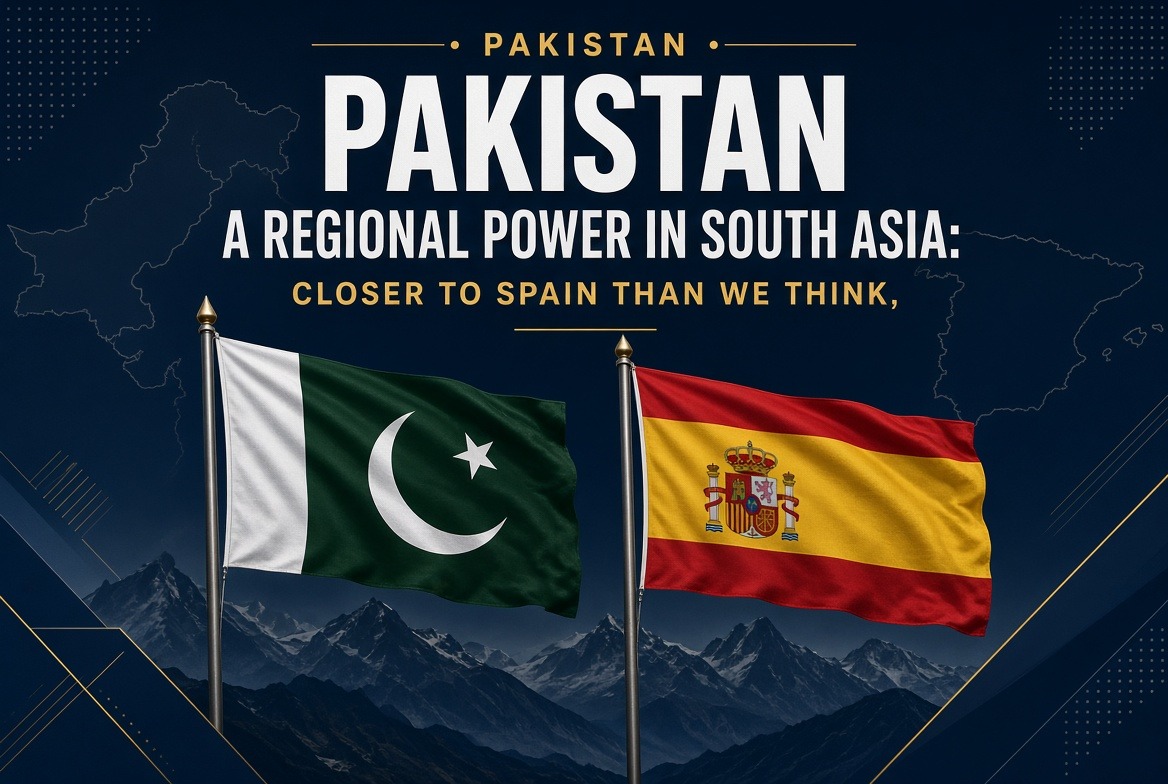
Islamabad(Sapeher Times) Pakistan, a Regional Power in South Asia: Closer to Spain Than We Think

On August 14, Pakistan celebrates the 79th anniversary of its independence from the British Raj in 1947. A new state was born, led by Mohammed Ali Jinnah, known as Quaid-e-Azam (“Great Leader”), who is regarded as the founding father of Pakistan. Today, it is a country situated between India and Afghanistan that is once again becoming key to understanding Asia. Trade relations between Pakistan and Spain have enormous potential. There is good cooperation in the fields of policing and migration. There is also a curious cultural connection: the cities of Córdoba and Lahore, the historic capital of Punjab, have been By Mr. Carlos Uriarte Sánchez, Professor of Law at the International University of La Rioja (UNIR), Spain CEU-Fernando III University of Seville, Pristina, and the Society for International Studies (SEI) sister cities since 1968. This link is due to the Pakistani national poet Muhammad Iqbal,who greatly admired Al-Andalus.
Large Pakistani communities have settled among us: they are our neighbours, entrepreneurs, students… many of them are already Spanish citizens
Pakistan is a country that seems quite far away from Spain, when in reality we are much closer than we think. Large Pakistani communities have settled in our country, particularly in Barcelona, Valencia and Logroño. More than 117,000 Pakistani citizens live in Spain and are well integrated, with many already belonging to the second generation (25,000 of them residing in Barcelona). Spain and Pakistan are strengthening cooperation on migration, returns and the fight against human-trafficking networks. There is an Afghan route used by people attempting to reach Spain through Pakistan. Both countries can cooperate in preventing Islamist radicalisation and terrorism. Pakistan is a nation paying the price of the Afghan
crisis five years after the Taliban returned to power. Islamabad is expelling Afghan citizens. Since 2023, more than 2.6 million Afghans have returned to Afghanistan. Islamabad accuses various armed groups, including the Tehrik-e-Taliban Pakistan (TTP), of using Afghan territory as a sanctuary for terrorists from which they launch attacks against Pakistan. The problem therefore has both a humanitarian and a military
dimension.
Pakistan is a country of great contrasts: a nuclear power (the only Muslim-majority country possessing nuclear weapons), with 240 million inhabitants (the fifth most populous nation in the world), and with major geopolitical importance as a key actor between China, India, Afghanistan and Iran; but at the same time, it faces major economic, social and structural problems (high debt and inflation and energy problems
aggravated by the crisis in the Strait of Hormuz), as well as border disputes with its neighbours Afghanistan and India. The paradox is extraordinary: a country capable of building and maintaining a nuclear arsenal while simultaneously having to turn to the IMF to stabilise its economy. This forces Islamabad to strike a difficult balance between China (its major strategic partner), the Gulf states, Europe, the United States and international financial institutions.
The connection between the two countries is not limited to migration Despite everything mentioned above, which is certainly real, there is also another Pakistan that is often overlooked by the Spanish media: its enormous textile industry, agriculture, technology, startups, universities, cinema and music, cricket, and a huge urban population in cities such as Lahore, its cultural centre; Islamabad, its administrative and political capital; and Karachi, its major cosmopolitan, commercial and port city. Spain has commercial interests, particularly in the agri-food sector
(Spanish exports to Pakistan increased by 75% in 2024 compared with 2023, starting from relatively small figures).
The European Union is one of Pakistan’s main economic partners. Trade in goods between the EU and Pakistan reached €12.2 billion in 2025. For Pakistan, the Union accounted for 14.1% of its total trade, whereas Pakistan represents only 0.2% of European trade in goods. This is therefore an asymmetric relationship, meaning that from a trade perspective Pakistan needs Europe more than Europe needs Pakistan. Nevertheless, this does not mean that Pakistan is irrelevant to Europeans. Quite the opposite. Its geographical position makes it a central chess piece on a board occupied by
other players such as India, China, Afghanistan, Iran and the Gulf. Its leadership within the Muslim world is highly significant: nuclear capability, a major non-Arab Muslim state in South Asia, a mediating role, and membership of the new defence alliance formed with Saudi Arabia and Turkey Pakistan stands out as a Muslim military power because it is the only Muslim-majority country possessing nuclear weapons. Its armed forces, in addition to their enormous size (660,000 active-duty personnel, making it the fourth-largest army in Asia by number of troops after China, India and North Korea), have extensive military experience. It also holds an important political position as a founding member of the Organisation of
Islamic Cooperation (OIC), which comprises 57 Muslim-majority states. Furthermore, its influence extends beyond the Arab world, and it is the major non-Arab Muslim power in South Asia, maintaining good relations with countries such as Turkey, Azerbaijan, Saudi Arabia, Iran and the countries of Central Asia. Pakistan does not have Saudi Arabia’s wealth or religious influence, nor Indonesia’s population, but it possesses something none of them do: nuclear weapons and an army of 660,000 personnel.
On August 7, Saudi Arabia, Pakistan and Turkey signed the Makkah Joint Defence Agreement, establishing a principle of mutual defence, military exercises, political and military coordination, intelligence sharing and cooperation in the defence industry. The emerging defence alliance would be open to the accession of additional states, including Egypt. The agreement strengthens the one already concluded in Riyadh on September 17, 2025, between Saudi Arabia and Pakistan. We should also remember that Turkey is a member of NATO. Pakistan is likewise playing an important mediating role between the United States and Iran.
With regard to China, Pakistan maintains a strategic partnership thanks to its geographical position in southern Asia, along the Arabian Sea and the Indian Ocean, particularly through the Pakistani port of Gwadar, which forms part of the ChinaPakistan Economic Corridor (CPEC), one of the major projects of China’s Belt and Road Initiative. Gwadar could also become an important pearl in what some analysts refer to as the “String of Pearls” strategy (a strategy that China does not officially recognise).
If understanding Spain requires understanding football, understanding Pakistan requires understanding cricket In conclusion, Pakistan today seeks to maintain relations simultaneously with China, the United States, Saudi Arabia, Turkey and Europe (through trade and immigration). At the same time, it continues to regard India unequivocally and as a priority as its rival. This rivalry dates back to the independence and founding of both nations in 1947 and their struggle for control of the historic regions of the former princely state of Jammu and Kashmir, located in the mountainous Himalayan region, whose sovereignty is disputed primarily by India and Pakistan, although China also controls part of the territory. It is therefore a rivalry that goes far beyond the one witnessed at the Cricket World Cup.